Why Proactive Exterior Maintenance is Your Roof’s Best Defense
As a homeowner, your roof is your primary line of defense against the harsh and unpredictable elements. Whether you are weathering the heavy snowfalls of an Alberta winter or the intense summer storms in Ontario, your roof is working tirelessly to protect your family, your belongings, and the structural integrity of your property. However, a roof does not operate in isolation. It is part of a complex, interconnected exterior system. Neglecting the maintenance of your home’s broader exterior can directly lead to unexpected, premature, and incredibly costly roof repairs. At True Contracting, with decades of combined experience serving homeowners as True Contracting – Ontario and True Contracting – Alberta, we understand that proactive care is the key to preserving your investment.
Many homeowners mistakenly believe that roof maintenance only involves looking at the shingles. In reality, the health of your roof is deeply intertwined with your gutters, your siding, your attic ventilation, and even the landscaping surrounding your property. When one of these exterior elements fails, the roof is often the next casualty. A clogged gutter can lead to rotting fascia boards and ice dams that tear shingles apart. Overgrown tree branches can strip protective granules from your roofing materials. Poor attic ventilation can literally cook your roof from the inside out. By adopting a comprehensive approach to exterior maintenance, you can significantly extend the lifespan of your roof, protect your high-end interior Home Renovations, and avoid the financial strain of emergency replacements.
1. Conduct Regular, Thorough Inspections
Consistent, detailed inspections are paramount to catching minor exterior issues before they escalate into catastrophic roof failures. We highly recommend conducting a comprehensive exterior and roof inspection at least twice a year—ideally in the spring to assess winter damage, and in the fall to prepare for the coming freeze. Furthermore, always perform a visual check after any severe weather event, such as a hailstorm or high winds.
- Roof Surface and Shingles: Using a pair of binoculars from the ground, carefully examine your roof surface. Look for shingles that are missing, cracked, curling at the edges, or buckling. Pay close attention to bald spots where the protective granules have worn away; these granules are essential for UV protection and fire resistance. If you notice significant granule loss accumulating in your gutters, your roof may be nearing the end of its functional life.
- The Critical Role of Flashing: Flashing is the thin metal material (often aluminum or galvanized steel) installed to direct water away from critical areas of the roof, such as where the roof plane meets a vertical surface like a dormer or chimney. It is also used around vents, skylights, and in the valleys of the roof. Inspect flashing meticulously for rust, cracks, loose sections, or gaps in the protective sealant. According to industry data, flashing failures are the most common cause of roof leaks—even more so than damaged shingles.
- Attic Interior Assessment: A true exterior inspection requires looking from the inside out. Safely enter your attic during daylight hours and turn off the lights. Look for any daylight peeking through the roof boards. Check the underside of the roof deck for water stains, damp insulation, or dark, moldy marks, especially near penetrations like plumbing stacks and vents. A persistent musty smell is a strong indicator of hidden moisture issues that could be rotting your roof deck.
2. Keep Gutters and Downspouts Clear and Functional
Gutters are the unsung heroes of your home’s exterior water management system. Their sole purpose is to capture rainwater and snowmelt from the roof and channel it safely away from your home’s foundation and siding. When gutters become clogged with leaves, pine needles, twigs, and debris, they fail to perform this critical function, leading to a cascade of expensive problems.
Clogged gutters cause water to back up and pool. In the warmer months, this pooled water can rot the wooden fascia boards that hold the gutters and support the edge of your roof. The water can also overflow, running down the side of your house, damaging your siding, and eventually pooling around your foundation, potentially leading to basement leaks—a nightmare if you’ve just invested in luxury Basement Renovations or Legal Secondary Suites. In the winter months across Ontario and Alberta, clogged gutters are a primary catalyst for ice dams. As snow melts on the warmer upper parts of the roof and flows down to the cold, debris-filled gutters, it freezes. This creates a dam that forces subsequent meltwater to back up under the roof shingles, penetrating the underlayment and leaking directly into your home.
- Cleaning Frequency: Most residential homes require gutter cleaning 2 to 6 times per year. A standard baseline is twice annually (spring and fall). However, if your property is surrounded by heavy tree coverage—especially pine trees that shed needles year-round—or if you live in an area prone to frequent storms, you may need to clean them 3 to 6 times a year to ensure unimpeded water flow.
- Proper Function and Alignment: Cleaning is only half the battle. Ensure your gutters are securely attached to the fascia board and are free of leaks at the seams. Check the pitch (the slight downward angle) to ensure water flows toward the downspouts rather than pooling in the middle. Downspouts must be firmly attached and should ideally direct water at least 3 to 5 feet away from your home’s foundation. Consider adding downspout extensions or splash blocks to prevent soil erosion and foundation pooling.
3. Trim Overhanging Tree Branches Proactively
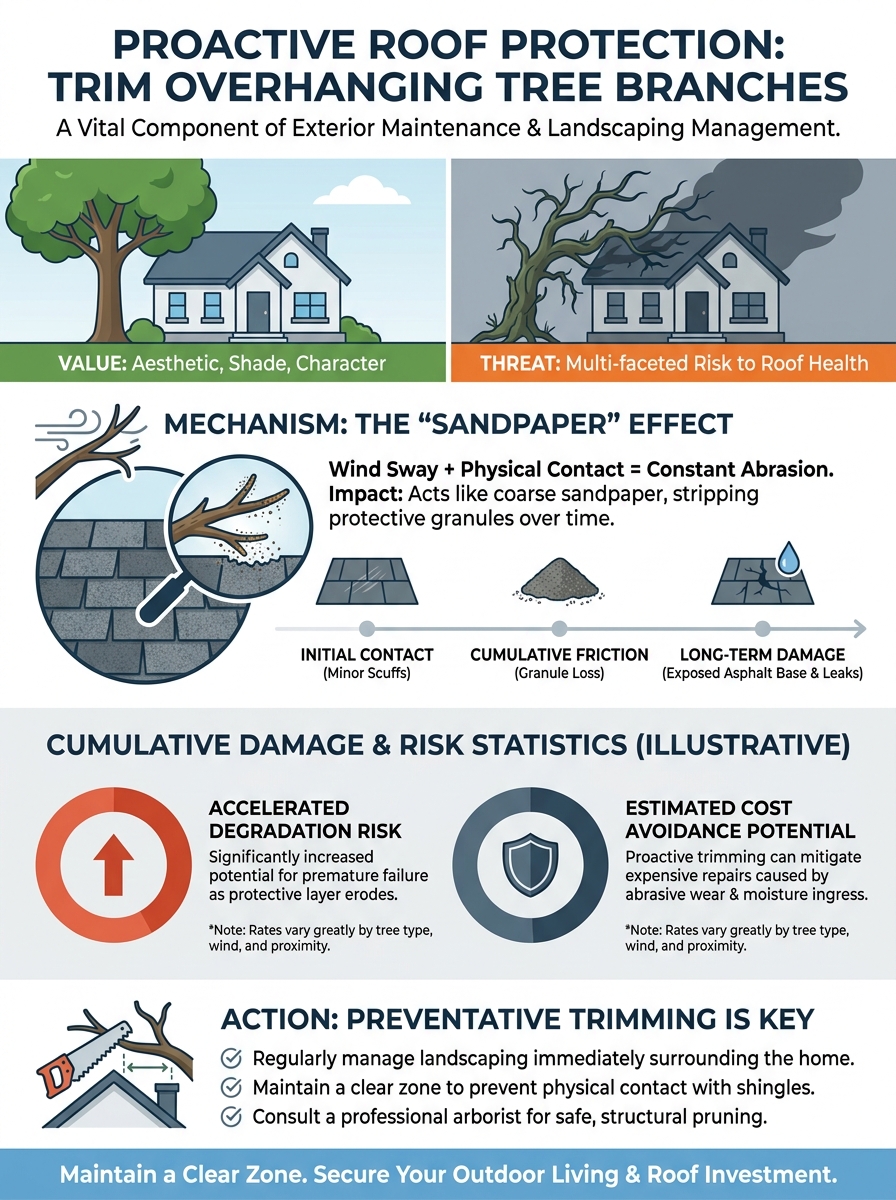
Mature trees add immense aesthetic value, shade, and character to your Outdoor Living spaces. However, overgrown branches pose a significant, multi-faceted threat to the health and longevity of your roof. Managing the landscaping immediately surrounding your home is a vital component of exterior maintenance.
When tree branches physically scrape against your asphalt shingles due to wind sway, they act like coarse sandpaper. Over time, this constant friction wears away the protective mineral granules on the shingles. Once these granules are gone, the underlying asphalt is exposed to the sun’s harsh UV rays, causing the shingles to dry out, crack, and fail prematurely. Furthermore, during severe storms, dead or weakened overhanging branches can snap and crash onto your roof, causing immediate structural damage, puncturing the roof deck, and leading to massive water intrusion.
- Maintain Safe Clearance: Proactively hire a professional arborist or tree trimming service to maintain a safe clearance of at least 10 to 15 feet between any tree branches and your roofline. This buffer zone accounts for the natural sway of branches during high winds and accommodates future growth. For exceptionally fast-growing tree species or homes located in high-wind corridors, a 15-foot or greater buffer is highly recommended.
- Mitigate Moisture and Pests: Overhanging foliage creates deep shade on your roof, preventing the sun from drying out morning dew or post-rain moisture. This persistent dampness creates the perfect breeding ground for moss, algae, and mold, which can degrade roofing materials and cause wood rot. Additionally, branches touching or hanging near your roof provide a convenient “highway” for pests like squirrels, raccoons, and rodents to access your roof, chew through your fascia or vents, and take up residence in your attic.
- Optimal Timing for Trimming: The best time for major tree pruning is typically in the late fall or early winter when the trees have gone dormant, or in the late winter just before new spring growth begins. Pruning during dormancy minimizes stress on the tree and reduces the risk of disease transmission.
4. Ensure Proper Attic Ventilation and Insulation
It might seem counterintuitive to think of the attic as part of your exterior maintenance routine, but the environment inside your attic directly dictates the lifespan of the roof above it. Good roof ventilation is absolutely crucial for maintaining a stable attic temperature and preventing destructive moisture buildup year-round.
A well-designed attic ventilation system relies on a balance of intake vents (typically located in the soffits under the eaves) and exhaust vents (located near or on the roof ridge). This system allows cool, fresh air to enter the attic from the bottom, pushing hot, moist air out through the top. When this system fails or is inadequate, the consequences for your roof are severe.
- Moisture Control in Winter: During the winter months, everyday household activities like cooking, showering, and running the dryer generate significant amounts of warm, moist air. This air naturally rises into the attic. If the attic is poorly ventilated, this moisture condensates on the cold underside of the roof deck. Over time, this chronic condensation leads to the growth of toxic mold and mildew, and eventually causes the structural wood of the roof deck and trusses to rot and fail.
- Temperature Regulation and Ice Dam Prevention: Proper ventilation is the primary defense against ice dams. By keeping the attic temperature closer to the outside ambient temperature, snow on the roof melts evenly and naturally, rather than melting rapidly at the top and freezing at the eaves. In the summer, inadequate ventilation turns your attic into an oven, with temperatures frequently exceeding 150°F (65°C). This extreme, trapped heat bakes your asphalt shingles from underneath, causing them to blister, curl, and age at an accelerated rate, while also driving up your home’s cooling costs.
5. Maintain Your Siding and Exterior Walls
Your home’s siding is not just for curb appeal; it acts as a protective, weather-resistant shield, directing water down and away from the structural framing. The health of your siding is inextricably linked to the health of your roof, particularly at the vulnerable intersections where the roofline meets vertical walls.
If your siding is damaged, cracking, or pulling away from the house, it allows wind-driven rain and moisture to penetrate the wall cavity. This moisture can travel upwards via capillary action or affect the structural integrity of the areas where the roof trusses anchor to the walls. Damaged siding near the roofline can also compromise the effectiveness of step flashing, allowing water to bypass the roof’s primary defenses.
- Regular Cleaning and Visual Inspection: Clean your siding annually—using appropriate methods for vinyl, wood, brick, or stucco—to prevent the buildup of dirt, grime, mold, and mildew. While cleaning, conduct a thorough visual inspection. Look for warping, cracking, loose panels, or any signs of moisture damage, such as peeling paint or soft spots in wood siding.
- Sealant and Caulking Checks: The integrity of your home’s exterior envelope relies heavily on sealants. Regularly inspect and reapply high-quality exterior caulk around windows, doors, trim boards, and any penetrations through the siding (like dryer vents or exterior light fixtures). Maintaining a watertight barrier on the walls ensures that moisture doesn’t migrate and compromise the roof structure from below.