The Rising Threat of Severe Weather: Why Proactive Basement Flood Protection is Essential
Across Canada, particularly in regions like Ontario and Alberta, weather patterns are shifting. Homeowners are experiencing an unprecedented increase in the frequency and intensity of heavy storms, flash floods, and rapid spring thaws. For many, the result is a homeowner’s worst nightmare: a flooded basement. Beyond the immediate, exhausting cleanup, water intrusion can lead to catastrophic structural damage, hazardous black mold growth, and the heartbreaking loss of cherished personal belongings and expensive home entertainment systems.
At True Contracting, we have witnessed firsthand the devastation that inadequate water management can cause. With decades of combined experience serving homeowners as True Contracting – Ontario and True Contracting – Alberta, we know that a dry, healthy basement is the foundation of a safe home. Whether you are planning comprehensive Basement Renovations, constructing Legal Secondary Suites, or embarking on Whole-Home Renovations, integrating proactive flood protection is no longer optional—it is a critical necessity. Waiting for the next torrential downpour to test your home’s vulnerabilities is a gamble you cannot afford to take. Here are the first three essential renovations that act as your home’s primary line of defense against severe weather.
- 1. Power Up with a Sump Pump (and Battery Backup!): Think of a high-quality sump pump as the beating heart of your basement’s flood prevention system. Installed in a specially excavated pit at the lowest point of your basement floor, this device automatically activates to pump out groundwater that accumulates around your foundation, discharging it safely away from your home. However, heavy storms frequently bring power outages. A standard sump pump is useless without electricity. That is why installing a robust, marine-grade battery backup system is a non-negotiable addition. This ensures that even when the neighborhood goes dark, your basement remains dry. When True Contracting undertakes high-end basement finishing, integrating a dual-pump system with a Wi-Fi-enabled alarm is often our first recommendation.
- 2. Regrade Your Landscape: Slope It Away: The most effective flood prevention strategies often begin before a single drop of water touches your home. Exterior grading refers to the angle of the soil surrounding your foundation. Over time, soil naturally settles, often creating a “negative grade” that funnels surface runoff directly against your basement walls. Proper grading ensures the ground slopes away from your home. Industry standards dictate a minimum slope of six inches over the first ten feet away from the foundation. By reshaping your landscaping, adding dense clay soil near the foundation walls, and utilizing strategic retaining walls if necessary during Outdoor Living renovations, you naturally redirect thousands of gallons of rainwater away from vulnerable areas.
- 3. Extend Your Gutters and Downspouts: Your roof acts as a massive umbrella, collecting vast amounts of rainwater during a storm. Your gutters and downspouts are responsible for managing this deluge. However, if your downspouts discharge water mere inches from your foundation, that concentrated volume will quickly saturate the soil, drastically increasing hydrostatic pressure against your basement walls. A highly effective and relatively simple renovation is extending your downspouts at least 6 to 10 feet away from the house. This can be achieved through above-ground extensions or, for a more aesthetically pleasing look during Home Additions or landscaping upgrades, buried underground discharge pipes that lead to a safe drainage zone or dry well.
Implementing these initial exterior and interior defenses significantly reduces the volume of water threatening your foundation. However, to achieve comprehensive protection, especially for high-value finished spaces, more advanced integrated systems are required.
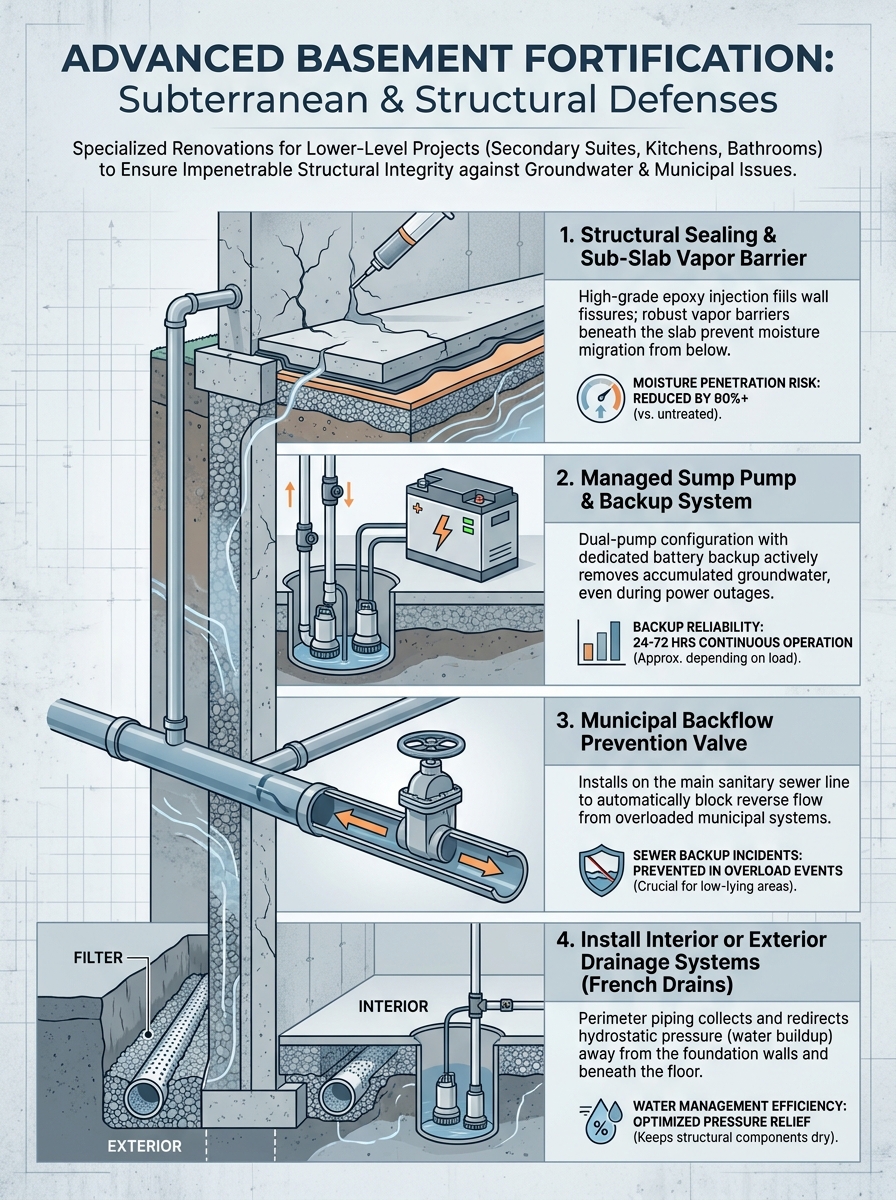
While surface water management is crucial, dealing with subterranean groundwater and municipal infrastructure requires specialized renovations. When designing Secondary Suites or undertaking complex Kitchen Remodeling and Bathroom Renovations in lower levels, True Contracting ensures the underlying structural defenses are impenetrable. Here are four advanced renovations to completely fortify your basement.
- 4. Install Interior or Exterior Drainage Systems (French Drains): When exterior grading isn’t enough to combat persistent groundwater, a French drain system is vital. An exterior French drain is installed at the base of the foundation footing during construction or by excavating around an existing home. It consists of a gravel-filled trench and a perforated pipe that intercepts water before it touches the wall. Alternatively, an interior weeping tile system (interior French drain) is installed along the inner perimeter of the basement floor. This system collects water that breaches the foundation and channels it directly to the sump pump. For older homes undergoing Whole-Home Renovations, installing an interior system is often the most cost-effective and reliable method to relieve hydrostatic pressure.
- 5. Backwater Valve Installation: Your Sewer’s Shield: Heavy, sustained rainfall can overwhelm municipal sanitary and storm sewer systems. When this happens, the massive volume of wastewater has nowhere to go but backward, potentially surging up through your home’s floor drains, lower-level toilets, and sinks. A sewage backup is a catastrophic health hazard and causes immense property damage. A backwater valve is a specialized plumbing device installed on your main sewer line. It features a one-way flapper that allows waste to flow out of your home but automatically slams shut if municipal wastewater attempts to flow back in. This is a mandatory code requirement for new Legal Secondary Suites in many municipalities across Ontario and Alberta.
- 6. Repair Foundation Cracks: Seal the Weak Points: Concrete is porous, and over time, settling, freeze-thaw cycles, and hydrostatic pressure can cause foundation walls to crack. Even hairline fractures can allow significant amounts of water to seep into your basement during a storm. As part of any foundational preparation for Garage Builds & Conversions or home additions, a thorough inspection is required. Professional foundation crack repair involves injecting waterproof epoxy or expanding polyurethane foam deep into the fissure. This not only seals the entry point against moisture but, in the case of structural epoxy, can actually restore the structural integrity of the concrete wall, preventing future movement.
- 7. Optimize Window Wells with Proper Drainage and Covers: Basement windows are fantastic for bringing natural light into a lower-level living space, but the corrugated metal or concrete wells surrounding them are notorious for collecting rainwater and snowmelt. If a window well fills with water, the pressure will eventually break the window seal, sending a waterfall into your basement. To prevent this, window wells must be excavated and fitted with proper vertical drainage pipes that connect down to your exterior weeping tile system. Additionally, installing custom-fitted, clear polycarbonate window well covers will deflect rain, snow, leaves, and debris while still allowing sunlight to brighten your newly renovated space.
By combining these seven critical renovations, homeowners can transform a vulnerable basement into a secure, dry, and valuable extension of their living space. Protecting your property requires a holistic approach, addressing everything from the tip of your roof to the deepest part of your foundation.